
How to Teach Your Dog to Lie Down (the 'Down' Cue)
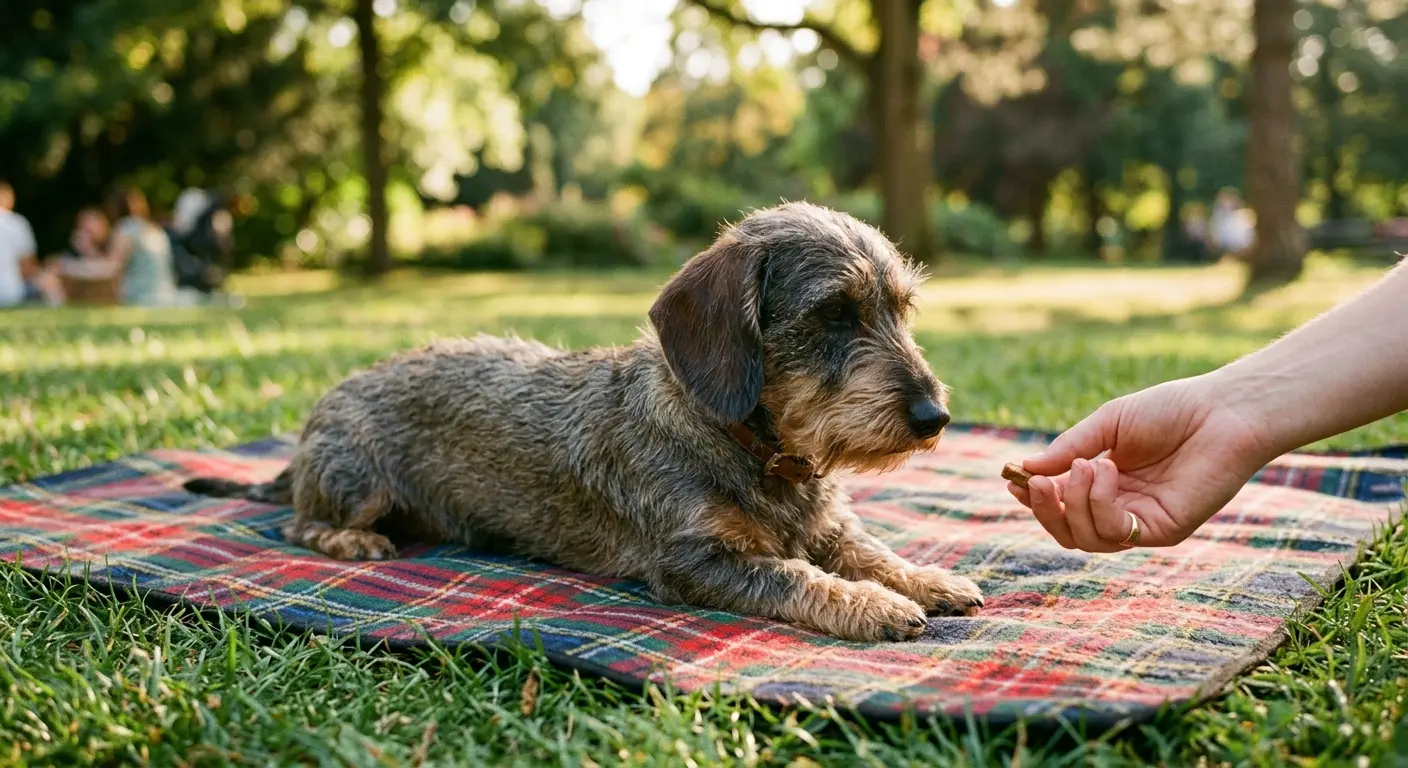
Down — lying flat on the floor — is one of the most useful things you can teach a dog, and it’s the cue people most often give up on. It’s harder than sit for a simple reason: lying down is a vulnerable position, so a dog has to be relaxed enough to choose it. Get the method right and you get more than a party trick. You get an off-switch: a calm default your dog can hold at the vet, under a café table, by the front door while you talk to a delivery driver.
Like sit, almost every dog can learn it force-free in a few short sessions — no pushing, no pressing on shoulders, no pulling the legs out. Here’s how.
Never force your dog down
First, the thing not to do: don’t push, pull, or press your dog into a down. Physically forcing a dog into a vulnerable position doesn’t teach the word — it teaches them to resist your hands, and for an anxious dog it can make lying down on cue feel unsafe. You want the floor to feel like a good place your dog chose to be. That only happens if the choice, and the reward, are theirs.
Set the scene
Down is easier when the surface is comfortable. A hard, cold floor is a lot to ask; start on a rug, a mat, or a bit of carpet. Pick a quiet moment when your dog is already a little settled rather than bouncing off the walls, and have small, soft treats ready to deliver quickly.
Method 1: Luring to the floor
Luring uses a treat to guide the movement. It works because the nose leads the body — follow the nose to the floor and the elbows follow.
- Start with your dog in a sit if they know one; a stand works too.
- Hold a treat at their nose, then move it straight down to the floor, right between their front paws.
- As their nose drops, slowly drag the treat a little toward you along the ground, like drawing an “L”. This tips them forward and their elbows sink down.
- The instant their elbows and belly reach the floor, mark it — a warm “yes!” or a click — and feed the treat right there on the ground.
- Let them get up, and repeat five or six times.
Keep the treat pressed close to the floor. If you lift your hand too early, your dog pops back up chasing it — which is exactly what you don’t want to reward.
For the dog who won’t fold: the tunnel trick
Some dogs lower their head but keep their bottom up. If that’s yours, make a tunnel they have to crawl under: sit on the floor with one knee raised, or use a low coffee table or a chair rung. Lure the treat under the gap so your dog has to drop their elbows to follow it. The moment they’re flat, mark and reward. After a few reps most dogs offer the down on their own and you can ditch the tunnel.
Method 2: Capturing (for the fidgety luring-resistant dog)
If luring turns into a wrestling match, capture the behavior instead. Keep treats handy while you go about a quiet evening, and every single time your dog lies down on their own, calmly mark and toss a treat. You’re not asking for anything — you’re just paying for a thing they already do. Within a day or two most dogs start lying down deliberately to make the treats happen. It’s slower to start than luring, but it produces a rock-solid, relaxed down because the dog chose it every time.
Fade the lure early
This is the step that separates a real cue from a bribe: stop luring with food within a session or two. If a treat is always leading the way, your dog is following the treat, not learning the word — and a dog who only lies down when they see food hasn’t learned “down”.
After a handful of good lures:
- Make the same downward hand motion with an empty hand, and reward from your other hand once they’re flat.
- Over several reps, shrink that motion until it’s a small hand signal — a downward point toward the floor is a perfectly good “down” cue on its own.
Add the word
Once your dog drops reliably from your empty-hand signal, attach the word. Say “down” once, in a calm, normal voice, just before the hand signal your dog already understands. Word first, then motion. After enough repetitions the word alone predicts the behavior, and you can fade the hand signal if you like.
Pick one word and keep it consistent — “down” or “lie down”, not both — and don’t let the family use “down” to also mean “get off the sofa”. A cue that means two different things means nothing.
Build duration: the real payoff
A one-second down isn’t much use. What makes down special is that your dog can hold it while life happens. Build that gradually:
- After your dog lies down, count a silent “one” before you mark and reward. Next time, “one-two”. Slowly stretch the time.
- Feed the occasional treat while they’re still lying down, not just at the release — this teaches that staying down is what pays.
- Give a clear release word (“okay!” or “free”) so your dog knows when they’re done, rather than deciding for themselves.
Keep the increases small and don’t climb in a straight line — mix easy reps in with the harder ones so your dog stays confident.
Take it into the real world
A down on your living room rug is not yet a down at the café. Dogs don’t generalize automatically, so practise in gradually harder places: a new room, the garden, the front step, a quiet pavement, then somewhere busier. Expect your dog to look a little lost the first time in each new spot — drop your criteria, make it easy, and build back up. This is normal, not backsliding.
Quick troubleshooting
| What’s happening | Likely cause | Fix |
|---|---|---|
| Dog pops back up chasing the treat | Hand lifted too soon | Keep the treat on the floor; mark the instant elbows land |
| Head goes down but bottom stays up | Not tipping forward | Drag the lure toward you, or use the tunnel trick |
| Only lies down when they see food | Lure never faded | Switch to an empty-hand signal, reward after |
| Won’t settle on hard ground | Surface too uncomfortable | Start on a mat or rug, add distractions later |
| Breaks the down after a second | Duration built too fast | Reward during the down; add time one second at a time |
Keep sessions short and kind
Two or three minutes, a few times a day, beats one long slog — especially for a position that asks your dog to relax. End while they’re still enjoying it, on a down they nailed. Taught this way, with the lure faded early and duration built slowly, most dogs have a calm, reliable down within a week.
Let Ruffy guide the way
Down is one of those cues that’s easy to teach badly and wonderful once it’s solid. The Ruffy app breaks it into short, force-free, guided sessions that adapt as your dog learns — so you always know when to fade the lure, when to add the word, and how to stretch the duration without losing it.
Download Ruffy free and give your dog a calm off-switch that lasts. 🐾
Keep reading
How to Teach Your Dog to Sit (Without Pushing on Their Bottom)
Sit is the first cue most dogs learn — and the one people teach with the least reliable method. Here's the force-free way to get a fast, happy sit in a few short sessions, and how to make it stick.
How to Teach Your Dog to 'Leave It' (a Cue That Can Save Their Life)
Dropped pills, chicken bones on the pavement, something dead in the grass — 'leave it' is the cue that stops your dog before they grab it. Here's the force-free way to build it, and why it works better than snatching things away.
How to Teach Your Dog to Stay (the Three D's Method)
A reliable stay isn't about your dog freezing on command — it's a skill you build in three directions. Here's the force-free method trainers use, step by step, with the mistakes that quietly undo it.