
Puppy Not Getting Potty Trained? 8 Reasons Why — and the Fix
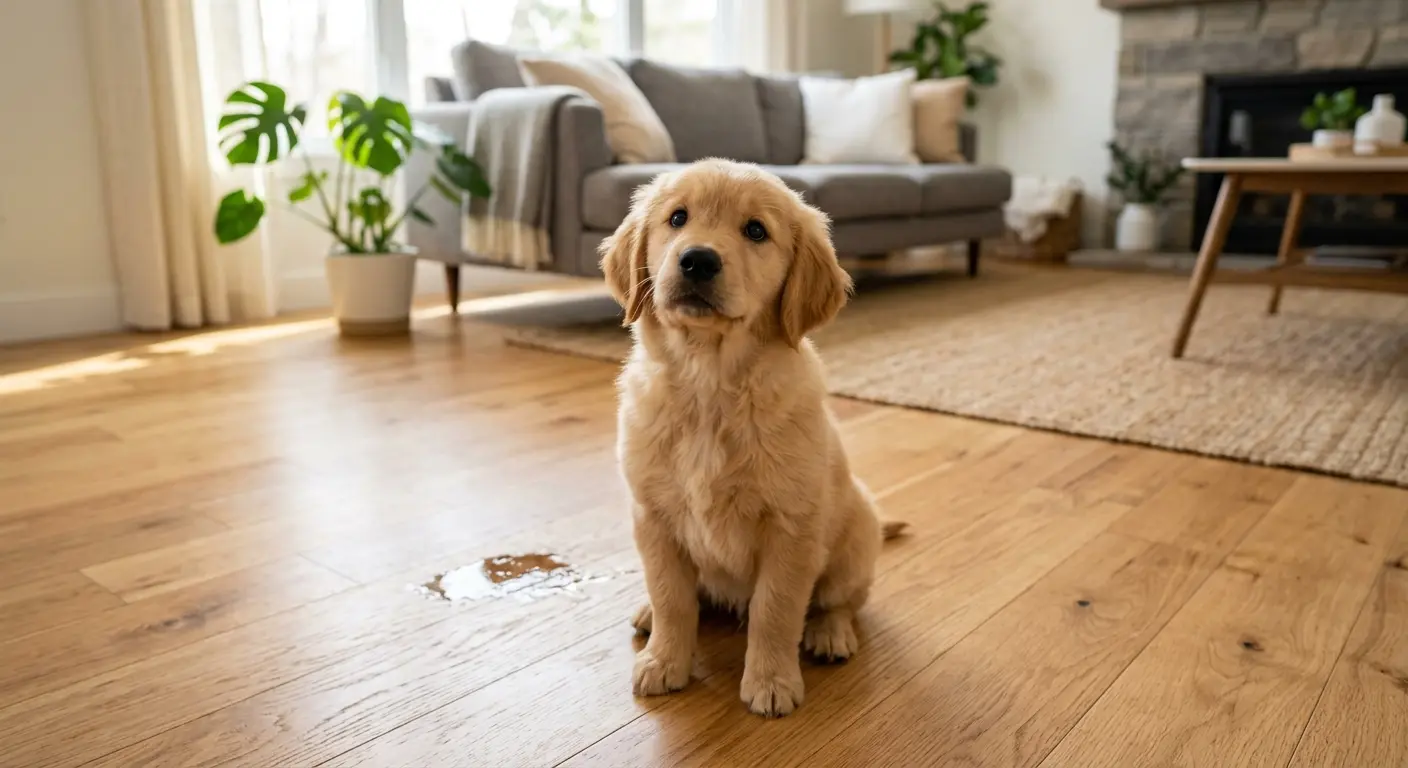
You’ve been taking your puppy out, rewarding the wins, sticking to the routine — and yet the accidents keep coming. It’s frustrating, and it’s easy to start wondering whether something is wrong with your dog. Here’s the reassuring truth: house training almost never fails. When it stalls, there’s usually one specific, fixable reason behind it.
This guide walks through the most common ones, from most to least likely, so you can spot what’s actually going on and fix it. If you haven’t set up the basics yet, start with our step-by-step potty training guide — this post is for when you’ve been trying and it isn’t clicking.
First, a reality check. Most puppies aren’t fully reliable until 4 to 6 months old, and the occasional accident before then isn’t a failure — it’s normal development. If your puppy is under ~4 months and mostly getting it right, you may not have a problem at all. Keep going.
1. Your puppy is simply too young
The single most common “problem” isn’t a problem at all — it’s expecting adult bladder control from a baby. A rough rule: a puppy can hold it for about one hour per month of age, plus one. An 8-week-old realistically needs a break every two to three hours, including overnight.
The fix: Match your schedule to your puppy’s actual capacity, not your convenience. Set a timer and take them out before they’d need to go, rather than waiting for a signal they may not give in time.
2. Too much freedom, too soon
If your puppy can slip into the next room unnoticed, they will — and they’ll often go the moment your back is turned. Unsupervised roaming is the number-one cause of “mystery” accidents you only discover later.
The fix: Until your puppy has gone weeks without an accident, they should always be either actively watched or comfortably confined to a crate or playpen. Tethering them to you with a leash indoors, or using baby gates to shrink their world, makes supervision realistic. A correctly sized crate is one of the fastest ways to build bladder control — see our crate training guide.
3. The schedule isn’t consistent enough
Puppies learn from patterns. If potty trips happen at random times, and meals are free-fed throughout the day, the body never settles into a predictable rhythm — and neither does the training.
The fix: Feed at set times rather than leaving food down all day. What goes in on a schedule comes out on a schedule. Take your puppy out at the same reliable moments every day: after waking, after eating, after play, and before bed.
4. Old accidents aren’t fully cleaned
Dogs return to spots that smell like a bathroom — and their noses are far better than ours. If a previous accident was cleaned with a regular household product, your puppy can still smell it and reads it as an invitation.
The fix: Clean every accident with a proper enzymatic cleaner, which breaks down the odor rather than masking it. Ordinary or ammonia-based cleaners can actually make a spot more attractive.
5. You’re rewarding in the wrong place — or too late
This one is subtle. If you praise and treat your puppy once they come back inside, you’re rewarding coming inside, not going potty. And if the treat arrives even ten seconds late, the connection is lost.
The fix: Reward the instant your puppy finishes, right there in the spot — calm praise and a treat within two to three seconds. Go outside with them every time, even in bad weather, so you can catch and mark the exact moment.
6. Punishment has taught them to hide it
If a puppy has ever been scolded, rubbed in a mess, or told off for an accident, they don’t learn “don’t go inside.” They learn “don’t go where the human can see me” — which leads to sneaky accidents behind the couch and a puppy who’s afraid to potty in front of you, even outdoors.
The fix: Stop all punishment completely. If you catch an accident happening, interrupt gently with a calm “oops,” scoop them up, and finish in the right spot. Rebuild trust by making every successful potty a small celebration. This often takes a couple of weeks to turn around.
7. Something changed, and they regressed
A puppy who was doing well and suddenly slips backward is usually reacting to a change: a house move, a new floor surface, cold or rainy weather they’d rather avoid, a new family member, or the start of adolescence. Teething can throw things off too.
The fix: Treat a regression as a temporary reset. Go back to closer supervision and more frequent trips for a week or two. If weather is the issue, make outside worth it — go out with them, keep it quick, and reward generously.
8. It could be medical
If your puppy was making steady progress and then regressed hard, is suddenly going far more often, straining, dribbling, or having accidents in their sleep or crate (where dogs normally avoid soiling), a physical cause may be behind it. Urinary tract infections are common in young puppies and make holding it genuinely impossible.
When to call your vet. Frequent squatting with little output, blood in the urine, straining, excessive drinking, or a sudden loss of previously solid habits all warrant a check-up. House training can’t succeed on top of an untreated medical issue — rule it out first.
Not every accident is a house-training problem
Two things often get mistaken for failed potty training:
- Excitement or submissive peeing — a small puddle during greetings, play, or when someone leans over them. This is an emotional response, not a bladder-control issue. Keep greetings calm and low-key, don’t punish it, and most puppies grow out of it.
- Marking — small, deliberate deposits on vertical surfaces, more common as puppies mature. It’s communication, not a lapse, and is handled differently from house training.
A one-week reset plan
If you’re not sure which reason applies, run this reset — it fixes most cases at once:
- Rule out medical if anything looks off (see above).
- Tighten supervision: puppy is watched or confined at all times.
- Reset the schedule: feed at fixed times, take out every 1–2 hours plus all the key moments.
- Go outside with them and reward within 2–3 seconds, every single time.
- Deep-clean every past accident spot with an enzymatic cleaner.
- Drop all punishment and keep it upbeat.
Give it seven consistent days. Most puppies turn a corner well within that window.
Train smarter with Ruffy
House-training hiccups are almost always about the system, not the dog — and getting the system right is exactly what the Ruffy app is built for. You’ll get a complete, step-by-step house-training course, plus crate training, basic obedience, and more — all force-free, science-backed, and designed to fit into a few minutes a day.
Download Ruffy free, get your routine back on track, and those puddles will soon be a memory. 🐾
Keep reading
How to Potty Train a Puppy: A Complete Step-by-Step Guide
Learn how to potty train your puppy fast with this vet-informed, step-by-step guide. Build a routine, prevent accidents, and use positive reinforcement that actually works.
How to Socialize a Puppy (Even Before Their Shots Are Done)
A clear, force-free guide to puppy socialization: why the first few months matter so much, how to do it safely before vaccinations are complete, and a checklist of experiences to cover.
How to Stop a Puppy From Biting (Without Punishment)
Puppy biting is normal — but it doesn't have to hurt. A calm, force-free guide to why puppies nip, how to teach bite inhibition, and what to do in the moment when those needle teeth come out.