
How to Socialize a Puppy (Even Before Their Shots Are Done)
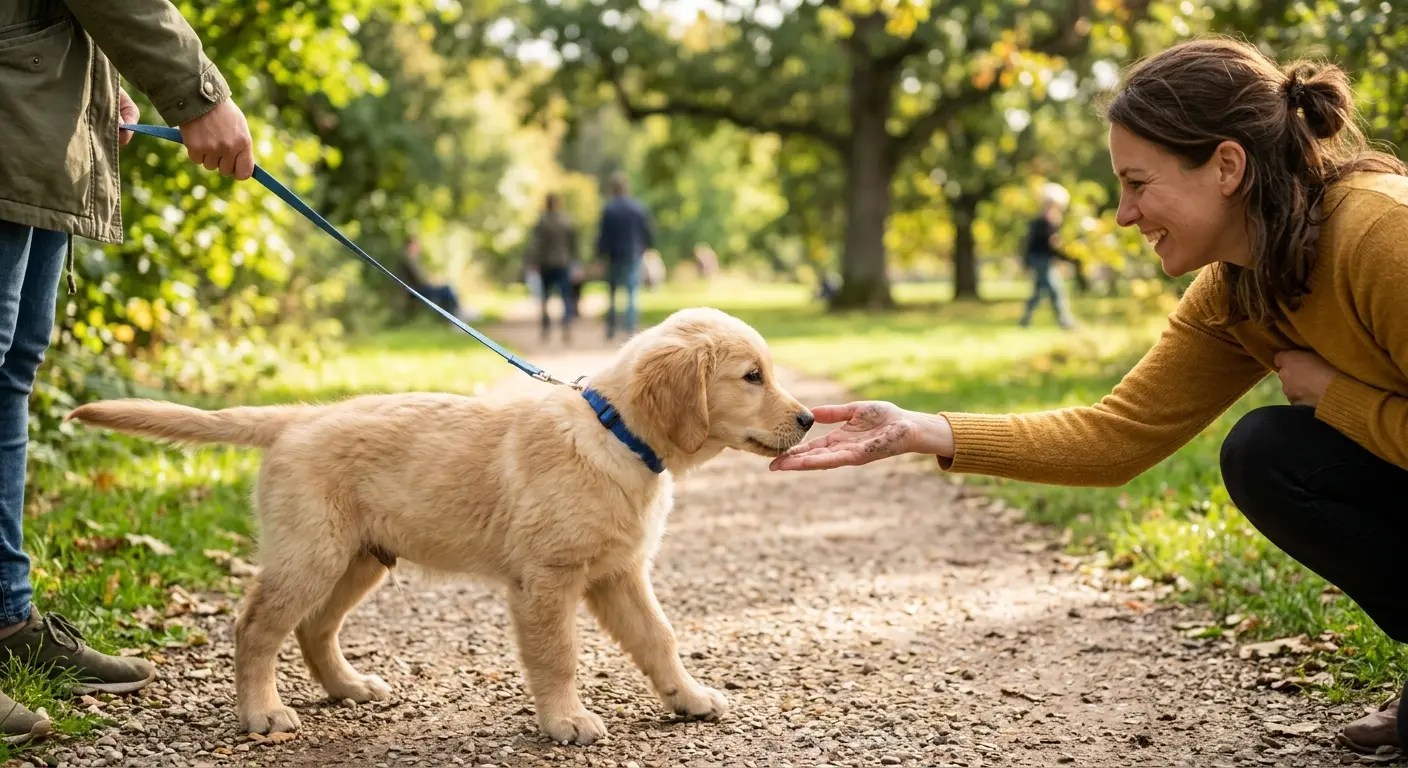
If you’ve brought home a puppy, you’ve probably heard the word “socialization” a dozen times already — from your vet, your breeder, other dog owners. It’s genuinely one of the most important things you’ll do in your puppy’s first few months. But it’s also widely misunderstood: socialization isn’t about maximizing playtime with other dogs. It’s about calmly introducing your puppy to the world so they grow into a confident, relaxed adult.
What socialization actually means
Good socialization is exposing your puppy to a wide range of people, animals, sounds, surfaces, and situations — in a way that feels safe and positive, not overwhelming. The goal isn’t just “meeting things.” It’s your puppy learning, again and again, that new experiences are no big deal.
A common misconception is that socialization means letting every puppy and every stranger approach and pet your dog. In reality, a handful of bad experiences (being cornered by an overly boisterous dog, being grabbed by a loud child) can do more damage than a dozen good ones can undo. Quality and your puppy’s comfort matter far more than quantity.
Why the first few months matter so much
Puppies go through a critical socialization window, roughly from 3 to 14 weeks of age, when their brains are especially open to learning that new things are safe. What they meet — or don’t meet — during this window shapes how they react to the world for the rest of their lives.
| Age | What’s happening | What to prioritize |
|---|---|---|
| 3–7 weeks | Still with the breeder in most cases; early handling and gentle novelty matter | Trust the breeder is doing early neurological stimulation and gentle handling |
| 7–12 weeks | Prime socialization window; puppy is highly impressionable and easily forms positive (or negative) associations | Calm exposure to people, sounds, surfaces, gentle handling — at home and on safe outings |
| 12–14 weeks | Window is still open but starting to narrow; some puppies get more cautious of new things | Keep up varied, positive exposure; don’t stop just because vaccines aren’t finished |
| 14 weeks+ | Window has mostly closed; a fear response to something new is more likely to “stick” | Maintenance — keep introducing new things, but foundational habits are now largely set |
By around 14 weeks, this especially open period is mostly over. That’s why waiting until your puppy is “fully vaccinated” — often around 16 weeks — to start socializing means missing most of the window entirely.
But what about vaccines? Balancing safety and socialization
This is the tension every new puppy owner runs into, and it’s a legitimate one: parvovirus and other diseases are real risks, but so is under-socialization. The good news is you don’t have to choose one or the other.
Veterinary behaviorists generally agree that puppies can — and should — begin socializing before their vaccine series is finished, as long as you manage the risk:
- Start at home. Invite calm, vaccinated, healthy adult dogs and a variety of people over. Your own home and yard are low-risk and endlessly useful for socialization.
- Choose low-risk outings. Carry your puppy through a busy parking lot, sit with them at an outdoor café table, or park the car near a school pickup line — they get to see, hear, and smell the world without touching the ground where unknown dogs have been.
- Use puppy classes early. Many trainers run puppy socialization classes for partially vaccinated puppies (after the first round of shots), held in cleaned, controlled indoor spaces — a well-run one is very low risk and high value.
- Avoid unknown dogs and high-traffic dog areas. Skip dog parks and areas with unknown vaccination status until your vet gives the all-clear.
- Ask your vet for their specific guidance. Local disease risk varies, and your vet can tell you exactly what’s safe in your area and on your puppy’s vaccine timeline.
The puppy socialization checklist
Work through categories, not just “dogs.” A well-rounded puppy has met a bit of everything:
- People — men, women, children, people in hats/sunglasses/uniforms, people with beards, people using wheelchairs or walkers, delivery workers.
- Other animals — calm, healthy, vaccinated adult dogs; cats (if safe to arrange); farm animals from a safe distance, if accessible.
- Sounds — vacuum cleaner, doorbell, traffic, thunder recordings, other dogs barking, kids shouting, fireworks recordings played at low volume.
- Surfaces — grass, gravel, sand, tile, metal grates, wobbly or unstable surfaces, stairs.
- Handling — gently touching paws, ears, mouth, and tail; nail trims; being picked up and held; being gently restrained like at a vet exam.
- Objects & equipment — umbrellas opening, wheelchairs, strollers, bicycles, skateboards, vacuum cleaners, the car and car rides.
- Environments — different rooms in the house, a friend’s house, a car park, a quiet park, a pet-friendly store.
You don’t need to check every box in week one. Spread it out and let your puppy set the pace.
How to socialize the right way
- Keep sessions short and positive. Five to ten calm, successful minutes beats an hour-long overwhelming outing. End on a good note.
- Let your puppy choose to approach. Don’t force or carry your puppy toward something scary. Let them investigate at their own pace, and reward curiosity.
- Pair new things with something good. Treats, a favorite toy, or calm praise while something novel is happening builds a positive association automatically.
- Watch their body language, not just their behavior. A puppy who freezes, tucks their tail, or tries to hide is telling you they’re over their limit — even if they aren’t growling or barking.
- Increase difficulty gradually. A quiet room with one calm stranger comes before a busy street market.
Signs your puppy is overwhelmed, not “getting used to it” Lip licking, yawning outside of tiredness, tucked tail, whale eye (whites of the eyes showing), trying to hide behind you, or freezing in place are all stress signals. If you see them, calmly increase distance or end the session — don’t push through. “Flooding” a puppy with more of what scares them rarely builds confidence; it usually teaches them the world really is scary.
What not to do
- Don’t force interactions. Letting strangers grab, hug, or loom over a hesitant puppy “to get them used to it” often backfires.
- Don’t let big or rowdy dogs overwhelm a puppy. One scary encounter with an overly rough dog can undo weeks of good work.
- Don’t skip socialization because of the vaccine gap. As above, there’s a safe middle ground — don’t wait until 16 weeks and miss the window entirely.
- Don’t stop once your puppy seems confident. Socialization tapers off but doesn’t fully stop; keep introducing new things through adolescence.
Build confidence one small step at a time with Ruffy
Socialization can feel like a lot to manage on top of everything else a new puppy needs. Inside the Ruffy app, you’ll find force-free, step-by-step lessons that guide you through socialization, handling, and confidence-building alongside all your puppy’s other foundational skills — a few focused minutes a day.
Download Ruffy free and help your puppy grow into a calm, confident dog who takes the world in stride. 🐾
Keep reading

How to Crate Train a Puppy: A Calm, Step-by-Step Guide
Learn how to crate train your puppy the gentle way. A vet-informed, step-by-step plan to build a safe den, stop the whining, and make the crate your puppy's favorite place.

How to Potty Train a Puppy: A Complete Step-by-Step Guide
Learn how to potty train your puppy fast with this vet-informed, step-by-step guide. Build a routine, prevent accidents, and use positive reinforcement that actually works.

How to Stop a Puppy From Biting (Without Punishment)
Puppy biting is normal — but it doesn't have to hurt. A calm, force-free guide to why puppies nip, how to teach bite inhibition, and what to do in the moment when those needle teeth come out.