
Dog Harness vs Collar: Which Is Better for Walks and Training?
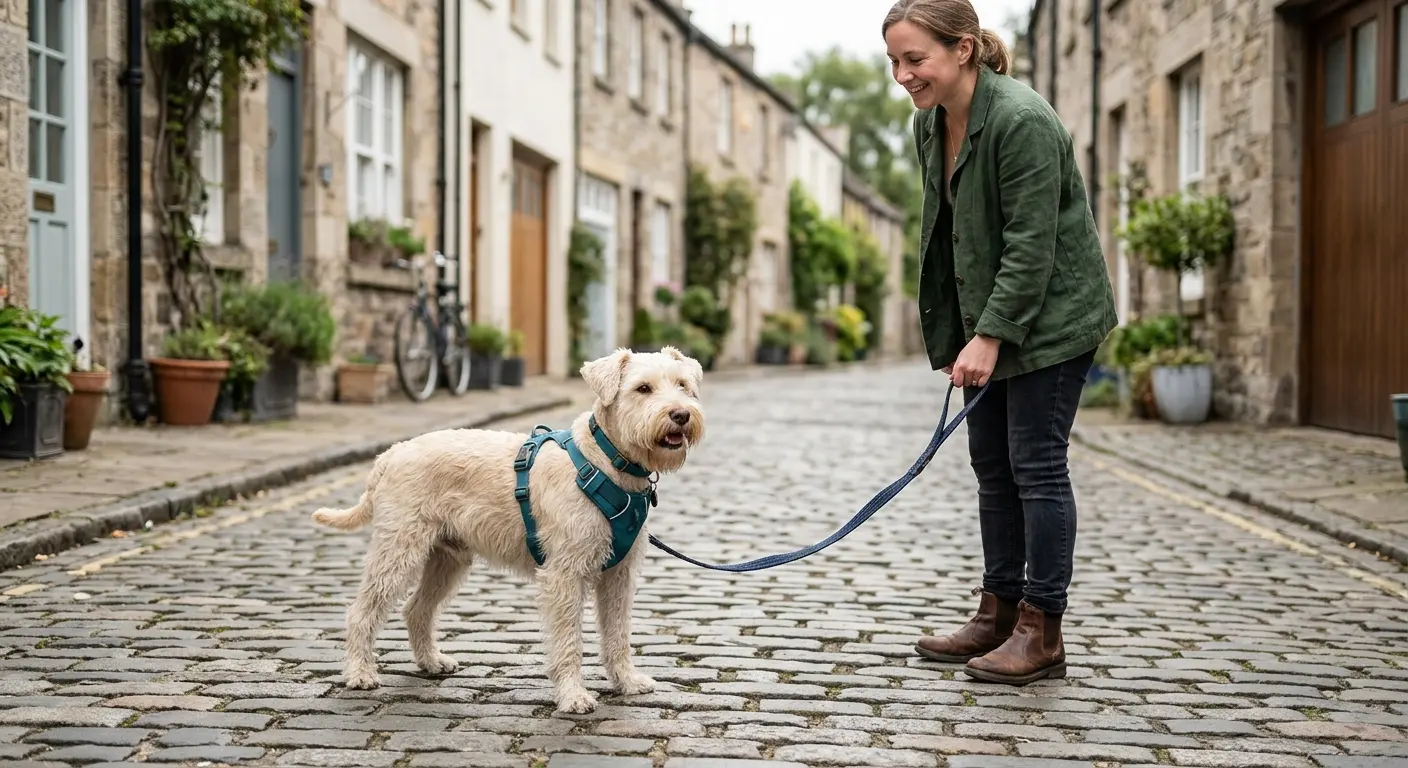
For most dogs, the best answer is not harness or collar. It is a comfortable harness for walks and a flat collar for identification, with reward-based training doing the real work.
A harness spreads leash pressure across the chest and torso, which makes it the safer walking choice for many puppies, strong pullers and dogs with delicate necks or airways. A collar is lighter, quicker to put on and useful for an ID tag—but repeated pulling against the neck is uncomfortable and can be risky.
Harness vs collar at a glance
| Question | Flat collar | Well-fitted harness |
|---|---|---|
| Everyday ID tags | Excellent | Possible, but usually less convenient |
| Dog already walks on a loose leash | Often suitable | Also suitable |
| Puppy or dog that pulls hard | Pressure is concentrated on the neck | Spreads pressure over a larger area |
| Coughing, neck injury or breathing concerns | Ask your vet before using for leash attachment | Often preferred, with veterinary advice |
| Escape risk | Some dogs can back out | An escape-resistant three-strap model may be safer |
| Giving the handler more control | Limited, without adding neck pressure | Front or dual attachment can help with management |
| Teaching loose-leash walking | Does not teach it by itself | Does not teach it by itself |
The phrase well-fitted matters. A harness that rubs the armpits, restricts the shoulders or lets the dog wriggle free is not a good harness simply because it avoids the neck.
When a collar can be a good choice
A simple, wide, flat collar is practical for holding identification and can be fine as the leash attachment for a dog who walks calmly without hitting the end of the lead. It is also useful for very short transitions, such as going from the house to the car, when the dog is comfortable and under control.
You should be able to slide two fingers comfortably beneath it. Check the fit as puppies grow and whenever an adult dog gains or loses weight. Remove or switch equipment if you notice hair loss, redness or rubbing.
Avoid using choke chains, prong collars or collars designed to tighten or deliver a shock. Pain or fear may suppress pulling in the moment, but it does not teach the dog what to do instead and can damage trust.
When a harness is the better walking option
A harness is usually the more forgiving choice if your dog:
- pulls or lunges and may hit the end of the leash;
- is a puppy still learning how walks work;
- has a small body, a delicate neck, or a history of coughing or airway trouble;
- needs extra security because they can slip out of a collar;
- joins you on a long line, hike or sniff-heavy walk.
If your dog coughs, gags, breathes noisily, seems painful around the neck or has a medical condition, ask your vet which equipment is appropriate. A harness can reduce neck pressure, but it is not a treatment and the right design depends on the individual dog.
Back clip, front clip or dual clip?
| Harness type | Best for | Trade-off |
|---|---|---|
| Back clip | Relaxed walks, small dogs and long-line sniffing | Gives little mechanical help with a strong puller |
| Front clip | Temporary extra steering while teaching leash skills | Can twist or restrict movement if poorly fitted or kept under constant tension |
| Dual clip | Flexible everyday use; a double-ended leash can attach front and back | Slightly more equipment to handle |
| Three-strap escape-resistant | Nervous dogs and dogs with narrow heads or deep chests | Fit must be checked carefully at the waist as well as the chest |
Look for a Y-shaped front that leaves the point of the shoulder free to move. Broad, soft straps and several adjustment points usually make a good fit easier. The harness should sit snugly without pinching, sliding sideways or pressing into the throat.
A five-point harness fit check
Before the first proper walk, check that:
- The neck opening sits at the base of the neck, not across the throat.
- The front forms a Y over the chest rather than a horizontal strap across the shoulders.
- The belly strap sits behind the front legs without rubbing the armpits.
- You can fit about two fingers under each strap, but cannot easily pull the harness over the dog’s head.
- Your dog can walk, trot, sit and lie down naturally without the harness rotating or shortening their stride.
Watch your dog move from the front and side. Recheck after ten minutes because straps can settle into the coat. For an escape-prone dog, test the fit indoors by applying gentle forward pressure while the dog steps backward—never by yanking.
Does a harness make a dog pull more?
A harness does not create pulling. Dogs pull because moving forward works: the lead becomes tight and they still reach the tree, dog or interesting smell. A comfortable harness may let a dog pull with more force than a collar, but discomfort at the neck is not a training plan.
Equipment manages the walk while training changes the habit. Start somewhere quiet, reward your dog beside you while the leash is slack, and move forward when the lead stays loose. If it tightens, pause or calmly change direction; then reward the moment your dog reconnects with you. Keep early sessions short enough for both of you to succeed.
Ruffy can help you practise loose-leash skills in small, repeatable sessions rather than expecting the equipment to solve the behaviour.
Using a harness and collar together
For many dogs, this is the most practical setup:
- Flat collar: current ID tag, fitted comfortably.
- Harness: leash attached here for normal walks.
- Safety connector: for a flight-risk dog, a short backup clip can join the harness to the collar without carrying normal leash pressure.
Never attach a long line to a collar. A dog can build speed before reaching the end, and the sudden force should be distributed across a suitable harness. Retractable leads also require care: the constant tension can make loose-leash learning less clear, and a dropped handle may frighten a dog.
The bottom line
Choose the equipment that keeps your dog comfortable, secure and able to move naturally. For a calm dog, either a flat collar or a well-fitted harness may work. For a puppy, puller, escape risk or dog with neck or breathing concerns, a harness is usually the better starting point.
Whichever you choose, check the fit regularly and pair it with patient, reward-based loose-leash training. The safest piece of walking equipment is the one that fits the dog in front of you—and is backed by skills you have practised together.
Keep reading
Why Does My Dog Bark and Lunge at Other Dogs on Walks?
Leash reactivity explained: why some dogs bark, lunge and pull at other dogs on lead, what makes it worse, and a calm, force-free plan to help them cope.
How Much Exercise Does My Dog Need Each Day?
A practical guide to daily dog exercise by age, health and temperament—with signs your dog needs more, or may be doing too much.
Why Does My Dog Eat Poop? (And How to Stop It, Kindly)
It's gross, but it's common and rarely a sign of something sinister. Here's what the science says about why dogs eat poop — their own, the cat's, or a horse's — plus the vet checks worth doing and the force-free way to stop it.